

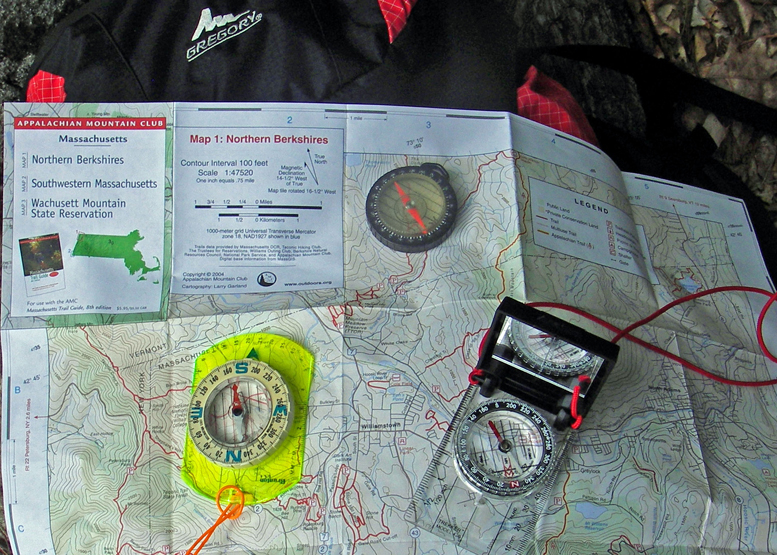
If you are properly prepared and know what you are doing, getting “lost” for fun is an adventure. Leaving the traveled trails behind, intentionally venturing into unexplored territory where you only generally know where you are is something everyone should try occasionally.
But getting lost for real is no fun at all and can be very, very dangerous. So staying “found,” at least to the extent of knowing approximately where you are and generally how to get to where you want to go, is a skill to cultivate.
I included “#7) Map and Compass and the know-how to use them” in my list of 11 Essentials For Hiking Safely. For emphasis I added that none of the three was as useful alone without the other two: it’s “Map and Compass Skills, ” not map or compass or skills
Of course one astute reader had to point out that people use maps without compasses all the time, and that a compass without a map can, at least, help you travel in a straight line across featureless country. That’s all true. It’s also true that an experienced woods traveler keeps a map going inside his or her head at all times, and often takes directional cues from the sun or stars, the lay of the land, even the wind moving the clouds. But you know what? If you are exploring in the thick woods of the northeast, whether by intent or because you’ve lost your way, you really want a map and compass skills, which means the tools and knowledge to put it all together.
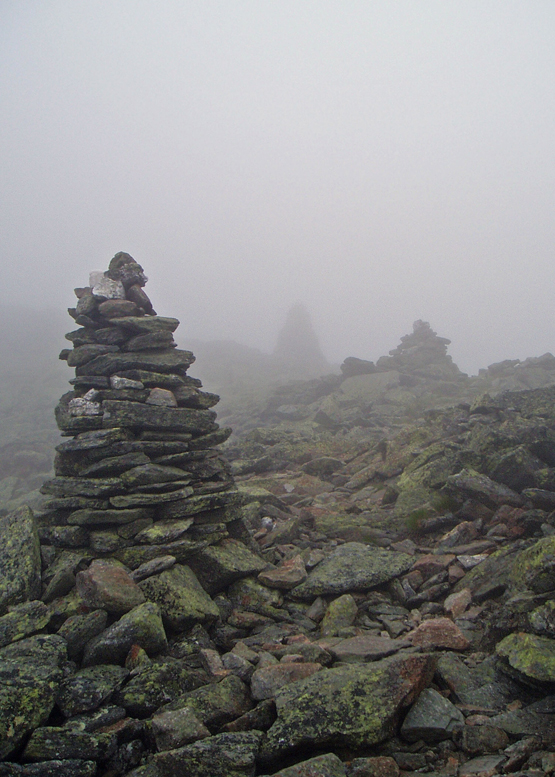
I’ve heard some old woodsmen say “I have a compass inside my head” and proclaim that they “never get lost.” That may be true, but I’ve never seen it. Usually it’s just a matter of their being very familiar with one area—but even that can fail. Many, many years ago, I was out wandering with one of these human compasses when a heavy fog rolled in. We were in country we both knew well and we still rattled around for quite awhile before I finally pulled out my pocket compass and got us safely back to camp.
There are books that will teach you how to get a map and a compass to work together properly. And there’s a very good beginner tutorial map and compass skills on line which can help get you started. But the very best and most fun way to learn is to spend a day at an orienteering event. For a list of Orienteering organizations, see below.
Orienteering, for those who haven’t tried it, is a timed sport where you use a map and compass to find your way to a number of checkpoints, Sometimes you can go by trail, sometimes not.
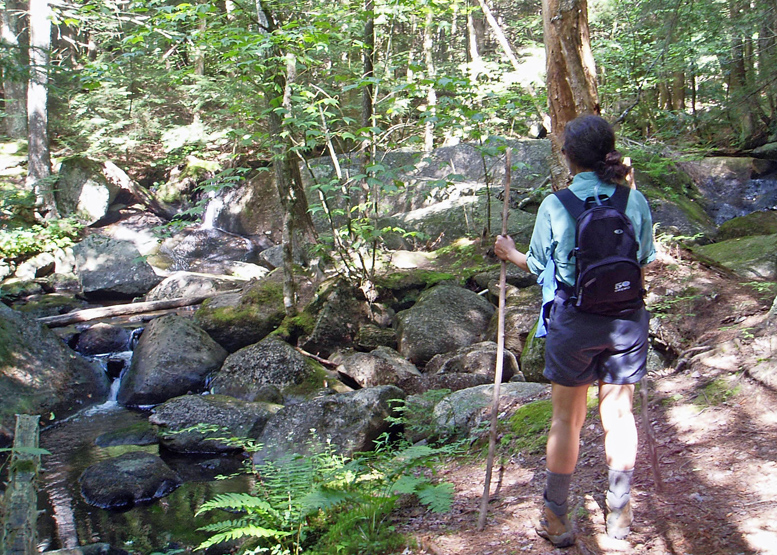
While the upper echelons of orienteering can get very competitive, most folks go orienteering to get a little exercise and have fun and learn how to navigate more efficiently. If you’re new to map and compass, someone will be happy to get you started. Most orienteering meets have courses ranging from super-easy to super-tough. Start easy and learn from there.
Why should you bother to learn map-and-compass skills in this age of GPS? For the same reason you still learn to write with a pencil and paper even though you have a smart phone. It’s basic technology that always works if you know how to use it. A GPS is great fun, handy at times, but it is useless if the batteries run out or if thick trees or high mountains block satellite reception.
Get yourself an orienteering compass
Orienteering Organizations
Connecticut, Massachusetts:
Western Connecticut Orienteering Club
New Hampshire:
New York:
Vermont:
Green Mountain Orienteering Club
Entire US